When Wearables Distort Time: Unintended Effects of Haptic Heartbeat Biofeedback on Temporal Cognition and Motor Performance
Abstract
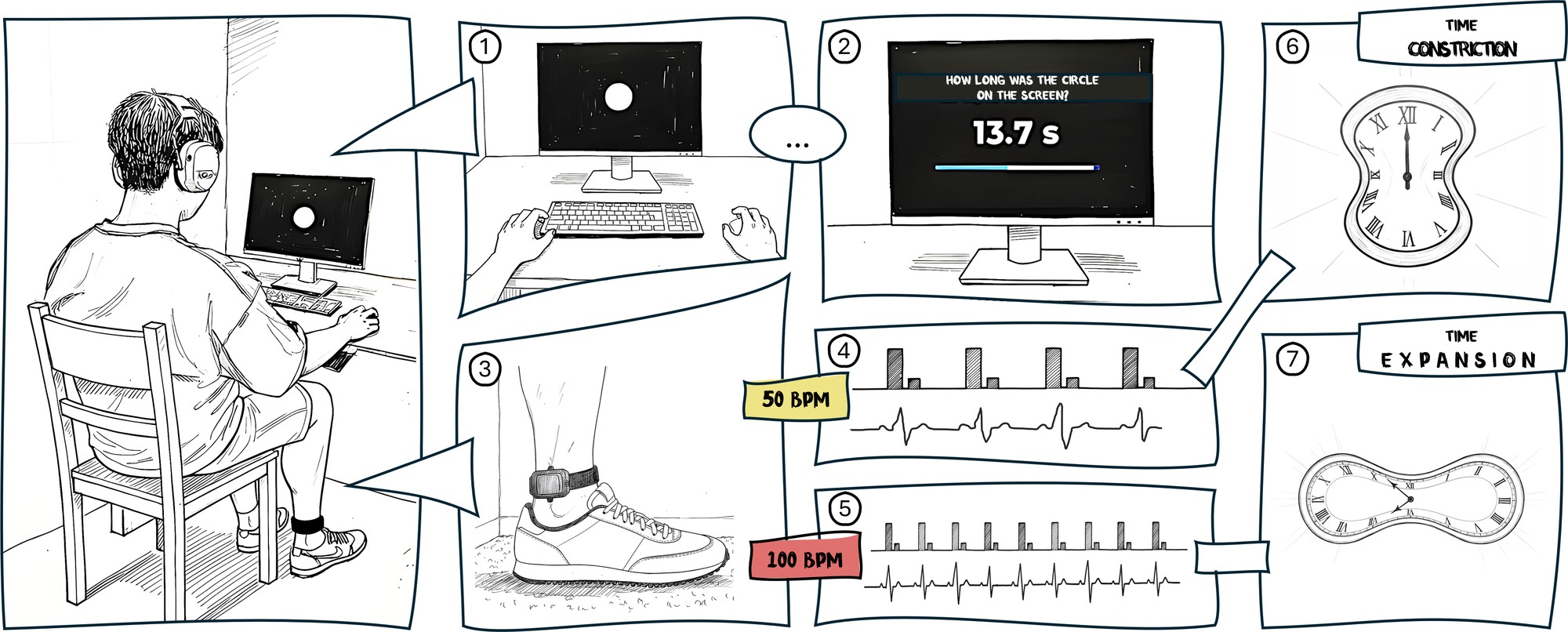
Wearable haptic heartbeat biofeedback is increasingly deployed in research systems for stress regulation and cognitive enhancement, yet designers lack guidance on how feedback frequency affects users' temporal cognition and motor performance, two processes that shape user experience in time-sensitive interactive systems. We present a study examining how a wearable haptic device delivering heartbeat feedback at 50 BPM and 100 BPM influences time estimation and reaction time. Slower feedback leads to time underestimation, while faster feedback causes overestimation and decreased heart rate variability. Both frequencies improved reaction times. Rhythmic feedback may also reduce natural cardiac-phase effects on motor performance, though we report this as preliminary. We evaluate these findings against three explanatory frameworks (interoceptive illusions, physiological modulation, and neural entrainment) to derive design knowledge for wearable haptic systems, establishing feedback frequency as a key parameter for ubiquitous applications sensitive to temporal perception and motor readiness.
Overview
Wearables increasingly deliver heartbeat-like haptic feedback to help people calm down, focus, or perform, and designers tend to treat that rhythm as a neutral background signal. This work asks what the rhythm itself does to two processes that matter in time-sensitive interaction: how long an interval feels, and how fast someone reacts. Participants wore an ankle device that pulsed at either 50 or 100 BPM while estimating the duration of on-screen events and responding to stimuli, with heart rate and heart rate variability recorded throughout. Rather than testing one theory, the study pits three accounts against each other, interoceptive illusions, physiological modulation, and neural entrainment, by looking for the conditions where their predictions come apart.
Takeaways
Three design-facing takeaways distilled from the study results and discussion.
Feedback frequency bends time in both directions
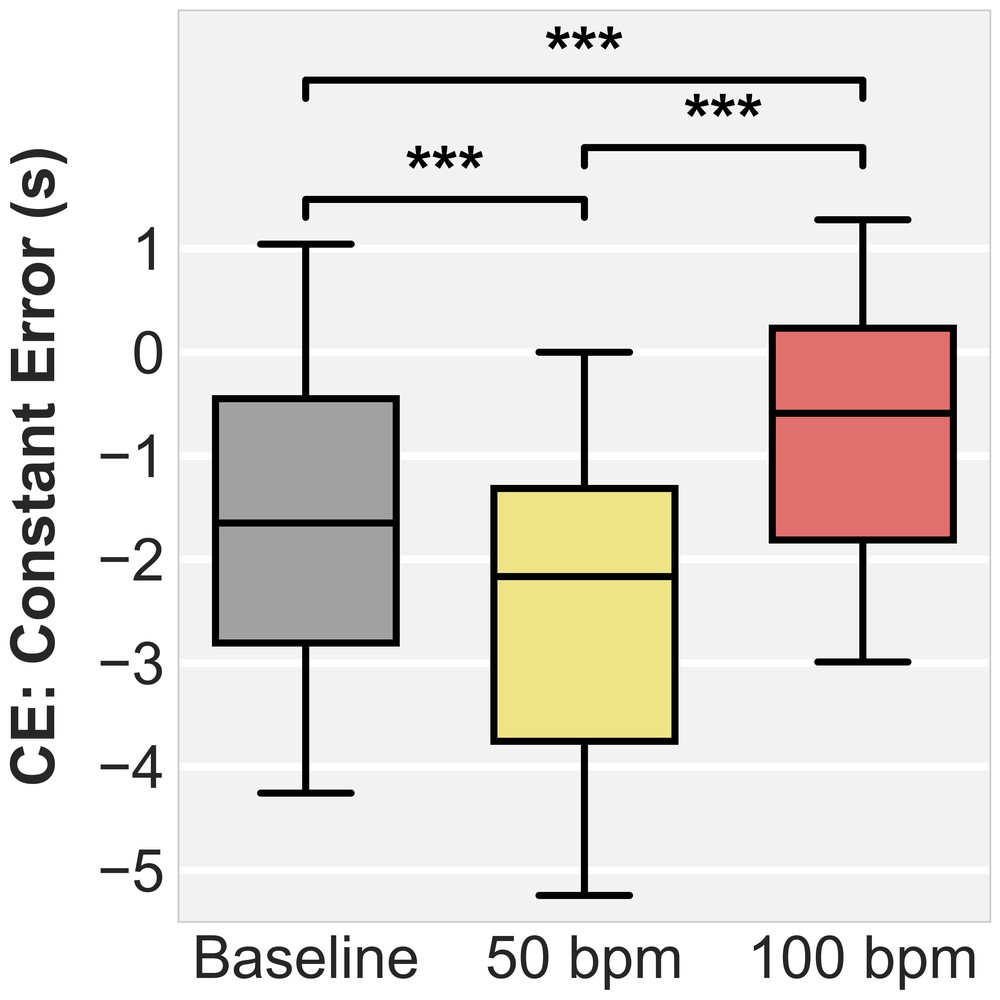
Slow 50 bpm feedback made people underestimate how long events lasted, while fast 100 bpm feedback made them overestimate. This bidirectional shift was the clearest and most robust effect in the study, so the rhythm itself, not just its presence, changes the felt passage of time.
In time-sensitive contexts such as driving or timed tasks, choose the rhythm deliberately. A slow pulse can compress perceived time, a fast one can stretch it.
The two rates act through different routes
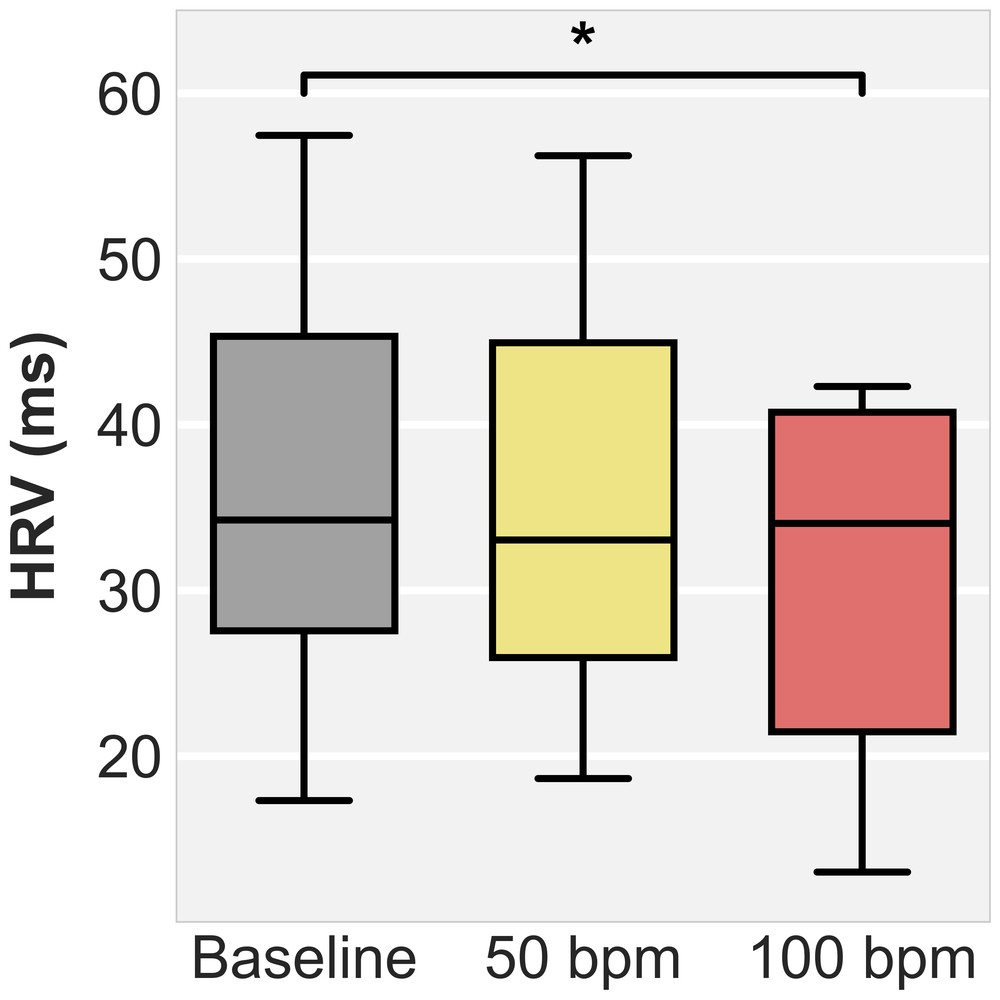
The 50 bpm effect came with no change in heart rate or heart rate variability, pointing to a purely perceptual interoceptive illusion. The 100 bpm effect coincided with a drop in heart rate variability, which implicates physiological modulation as well. Different frequencies recruit different underlying processes.
Measuring behaviour and physiology together separates a perceptual illusion from an autonomic shift, which matters for predicting when an effect will generalize.
Both rhythms speed reactions, and may blunt cardiac-phase timing
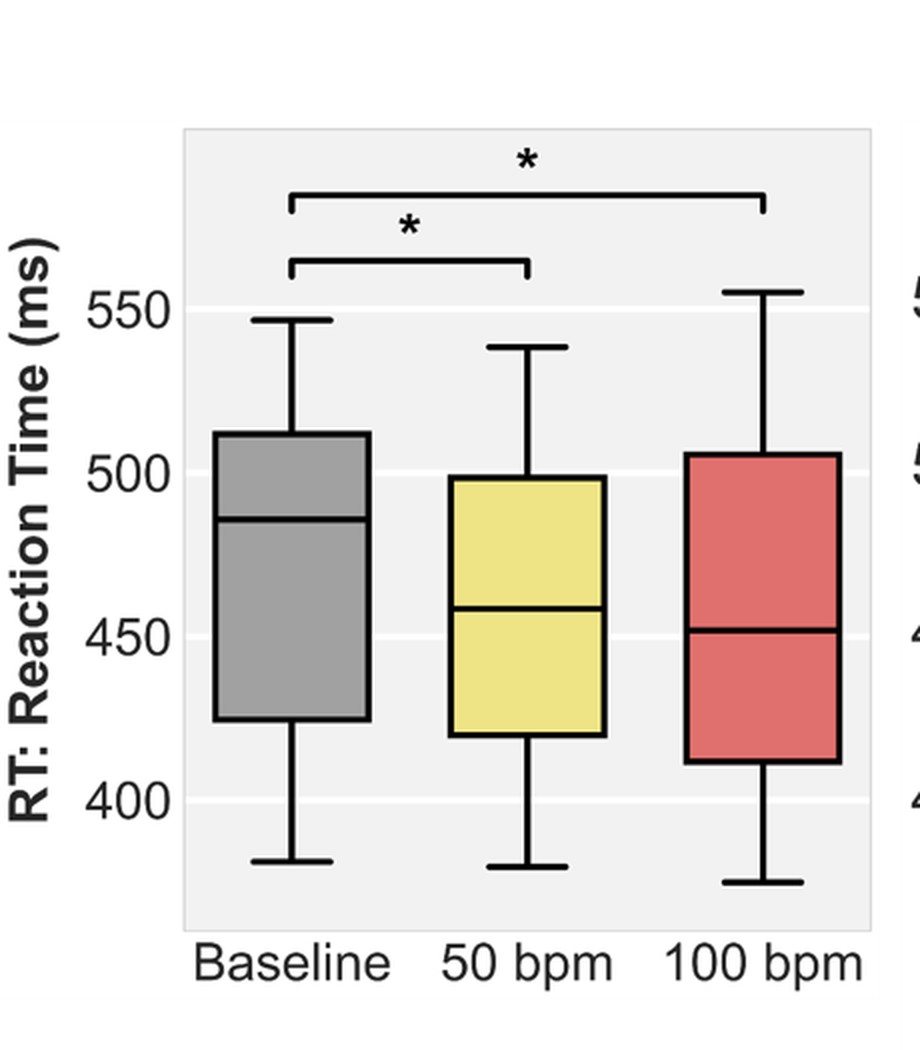
Reaction times dropped under both 50 and 100 bpm relative to no feedback, a benefit independent of rhythm speed and consistent with neural entrainment. A preliminary observation also suggests rhythmic feedback may reduce the usual slowing of responses during systole.
Rhythmic haptic feedback can sharpen motor readiness, but treat the cardiac-phase effect as preliminary until it is replicated.
Citation
APA
Valente, A., Billinghurst, M., & Esteves, A. (2026). When wearables distort time: Unintended effects of haptic heartbeat biofeedback on temporal cognition and motor performance. Proceedings of the ACM on Interactive, Mobile, Wearable and Ubiquitous Technologies, 10(4), Article 256. https://doi.org/10.1145/3857955
BibTeX
@article{valente2026wearables,
  author    = {Valente, Andreia and Billinghurst, Mark and Esteves, Augusto},
  title     = {When Wearables Distort Time: Unintended Effects of Haptic Heartbeat Biofeedback on Temporal Cognition and Motor Performance},
  year      = {2026},
  month     = dec,
  journal   = {Proceedings of the ACM on Interactive, Mobile, Wearable and Ubiquitous Technologies},
  volume    = {10},
  number    = {4},
  articleno = {256},
  numpages  = {27},
  publisher = {Association for Computing Machinery},
  address   = {New York, NY, USA},
  doi       = {10.1145/3857955},
  url       = {https://doi.org/10.1145/3857955}
}